
SYLVIA OSTRY (nee Knelman)
1927 – 2020
As a child, I had two pictures in my room. One was of
Lord Byron, and the other of Madame Curie. Lord Byron
is the romanticism in me, the art, the literature, the
emotionalism, and the culture. And Madame Curie
represented for me the scientist, the woman of pure intellect.
-Sylvia Ostry
Harry and Mildred Gutkin’s The Worst of Times The Best of Times consists of chapters delineating the lives of prominent Winnipeg Jews that emerged from the North End. These are perceptive and illuminating interpretations of personalities whose lives and accomplishments resonate with the contradictions, ambiguities, and complexities of North End Jewish life. Some of the finest pages are dedicated to Sylvia Ostry. Ostry’s exemplary life and contributions were a product of a fundamentally analytical and critical mind, nurtured in the “community of her childhood”. She told the Gutkins that “the search for intellectual ideas, the excitement of the world of the intellect, the emphasis on education” were inherent to “understanding that the way out of the ghetto had to be through some kind of ladder that involved excellence”. It was in the fields of economics and civil service that Sylvia Ostry was to leave a lasting mark of excellence.
Sylvia Ostry was born in Winnipeg on June 3, 1927, to Morris and Bess Knelman (nee Stoller). Her father a cantor in Ukraine aspired to be an engineer. Eventually he went into the wood pulp business. Sylvia’s mother was born and educated in London where she earned a teaching diploma. In Winnipeg she taught at an elementary school on Dufferin Avenue as well as English language evening classes for immigrants. Ostry referred to his father as “an atheist out of intellectual conviction… secretary of a socialist club preoccupied with the lot of mankind” and very much an “intellectual manque’”. He went into business not out of interest or passion but by sheer necessity. Ostry had a strong relationship with her mother, whom she described as “not an intellectual atheist like my father but with no attachment to formal religion”. Her paternal grandfather was devoutly orthodox, a situation which caused some tension between father and son but did not deter from their mutual affection and respect. Sylvia Ostry identified herself as an agnostic very much grounded in a secular worldview, though with great candour she admitted to the Gutkins that there were times as a child she “rather envied the children whose parents sent them to synagogue on the High Holy Days, and I would go along with my friends. My parents didn’t object”. Her brother Fred, who would study engineering, and later taught science and human affairs at Sir George Williams College in Montreal, had a Bar Mitzvah, probably due to the grandfather’s influence, but he too would develop what Ostry labelled “the intellectual skepticism and yearnings of my father”. Though her father could speak Yiddish and Russian, the family communicated in English. She picked up a few words of Yiddish from her paternal grandfather. Her mother knew enough Yiddish to be able to communicate with her in-laws.
Sylvia Ostry attended St. John’s Tech High School. It was there that she met her future husband, Bernard Ostry, who was to become an author, philanthropist, and civil servant. Ostry decided to go into medicine and was admitted into the University of Manitoba at a time when the quota system worked against Jewish students. Though she was an excellent student, she found the courses tiresome and boring. She informed the Dean of the medical faculty Alvin Mathers of her decision. Mathers was a notorious antisemite and sexist. He told her: “You will never get a PhD. You are leaving for the same reasons all women leave because you want to get married. You had no intention of practicing medicine. This is why we don’t want women in medical school”. Ostry changed her field of interest and graduated with a BA (1948) and MA (1950) in Economics. She applied for her doctorate at McGill and was awarded a travelling fellowship at Cambridge where she completed her degree. She returned to McGill to lecture. With the completion of the teaching year, Ostry took a job as Research Officer at the Oxford University Institute of Statistics. In England, she reconnected with Bernard who was working on his PhD in history at the London School of Economics. They were soon to wed and had a child (Adam). A second son, Jonathan David, was born in 1962. This was her second marriage. A few years earlier she had married Henry Wiseman, whom she met when visiting her brother Fred who was studying at Queen’s University. In her own words, she had been too young, and the marriage was a mistake. Soon they were to divorce.
Sylvia Ostry returned to Canada in 1958 where she was hired with the Department of Labour in Ottawa.
Dissatisfied with her job she returned to McGill where in 1962 she became an associate professor. Three years later Ostry was hired as Director of Special Manpower Studies at the Dominion Bureau of Statistics and in 1969 she went to the Economic Council of Canada, as Director and Assistant Deputy Minister. In 1972 she was appointed Chief Statistician at Statistics Canada, a position she was to hold until 1975 when she became Deputy Minister and Deputy Registrar General of the Department of Consumer and Corporate Affairs.
Sylvia Ostry continued to climb the ladder of success. In 1978 she became one of the country’s highest ranking and influential civil servants by assuming the Chair of the Economic Council of Canada. A year later Ostry became head of the Department of Economics and Statistics of the Organization for Economic Co-operation and Development, based in Paris. Other high caliber positions were to follow. These included Deputy Minister of International Trade Coordinator of International Economic Relations for the Government of Canada (1984-85), Ambassador for Multilateral Trade Negotiations, the Prime Minister’s personal representative at economic summits (1985 – 1988), and Chair of the National Council of the Canadian Institute of International Affairs (1990 – 1995). Ostry also served on the academic advisory board of World ORT (Organization for Rehabilitation through Training), whose aim is to ameliorate lives through education and vocational programs “driven by Jewish values”, was Chair of the Munk Centre for International Studies at the University of Toronto and sat on the Board of the Bank of Montreal.
Sylvia Ostry was credited with over eighty publications, mostly on economic policy and globalization. She was the recipient awards including eighteen honorary degrees from Canadian and other universities, Officer of the Order of Canada (1978) and Companion of the Order of Canada (1990). She established the Sylvia Ostry Foundation which since its inception in 1992 has sponsored an annual lecture on international affairs.
In 1993 Sylvia Ostry returned to Winnipeg to deliver the Distinguished Scholar Lecture to celebrate the 25th anniversary of the Jewish Historical Society. Titled Canada in the Global Village the talk took place at the Shaarey Zedek Synagogue.
Sylvia Ostry passed away on May 7, 2020, in Toronto. Her son Jonathan said, “She was a pioneer, a great Canadian, who was dedicated to improving lives. She had tremendous integrity, and she was a dedicated public servant”.
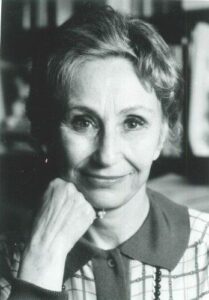
Silvia Ostry (JM 3546)
Suggested reading
Brown, Michael. Sylvia Ostry. Jewish Women’s Archive. https://jwa.org/encyclopedia/article/ostry-silvia

Gutkin, Harry and Mildred Gutkin. The Worst of Times The Best of Times. Markham: Fitzhenry &

  Whiteside, 1987

Lafontaine, Miriam. “Former public servant and economist Sylvia Ostry dies at 92”. Toronto Star

  https://www.thestar.com/news/gta/former-public-servant-and-economist-sylvia-ostry

Silk, Andrew. “Lecture marks Jewish Historical Society’s 25th anniversary. Jewish Post & News,

  Wednesday, December 8, 1993, p. A7